A day in the life of a plant that said yes
Twenty-four hours in a plant that automated the right stations and not the wrong ones. It is a composite, assembled from the published deployments in our casebook and the arithmetic in our guides, so the plant is imagined and every number is somebody's real one. Walk it from the dock at dawn to the scrubber at three in the morning.
The short answer
Picture a sixty person plant that makes metal and plastic parts, assembles some of them, and ships cases of finished goods on pallets. Over four years it automated seven stations, each one chosen because the arithmetic said so and skipped where it did not. Nothing about it would make a film. Everything about it would make a payroll. What follows is one day in that plant. The plant is a composite built from the published accounts in this site's casebook and the planning ranges in its guides. The scenes are imagined. The numbers are not.
5:40 AM, the dock
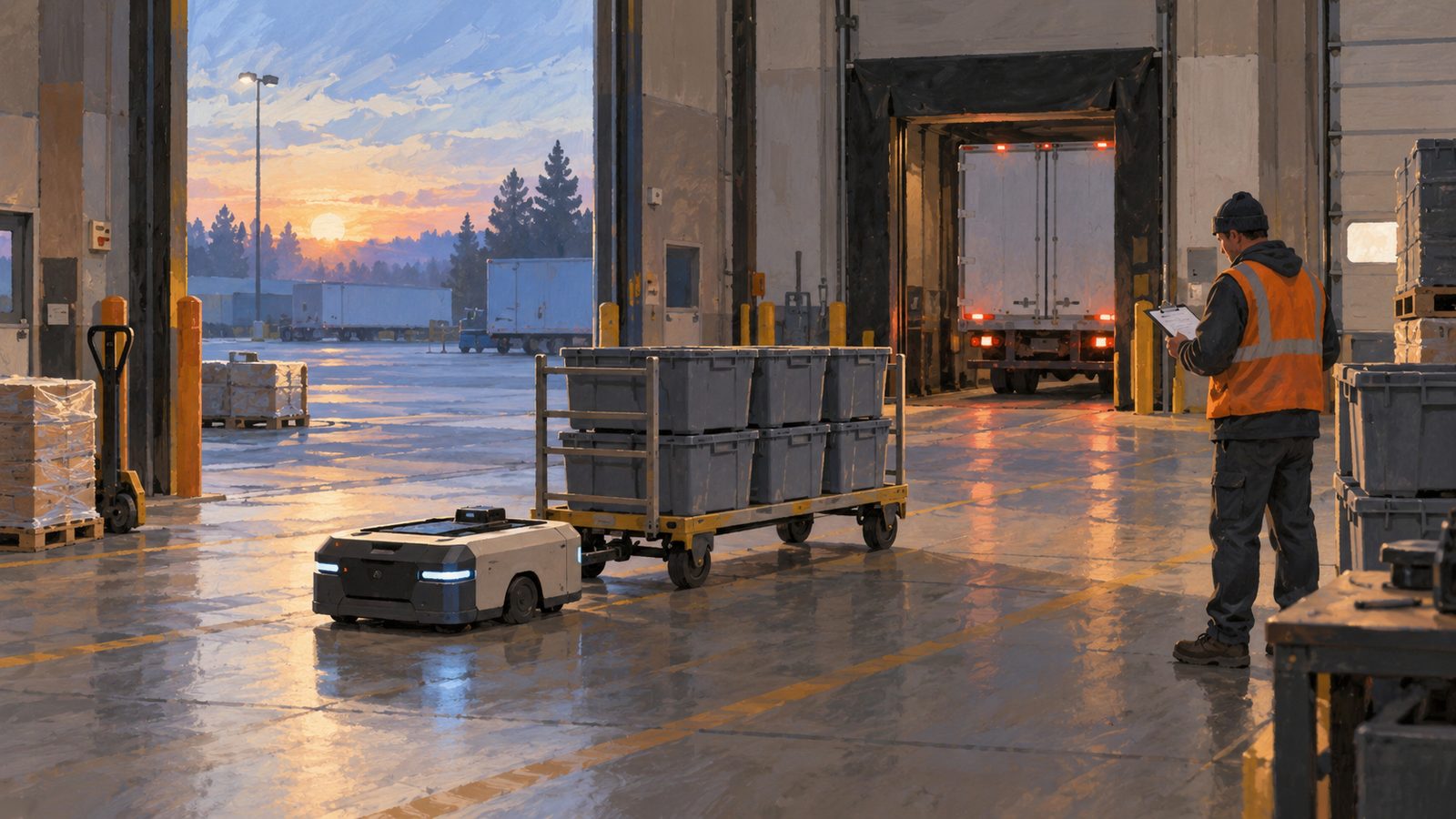
The first truck backs in before the first shift clocks on, and the first machine to move is not an arm. It is a low mobile robot with a cart hook, running the loop it runs every morning: dock to raw material staging, staging to the first presses, empties back. Nobody drives it. A material handler who used to spend about two and a half hours a day walking totes now spends the first hour of her day checking the inbound paperwork against what is on the floor, which the plant used to discover was wrong at ten.
The published account that inspired this is a New Jersey power electronics plant where two mobile robots run scheduled bus routes between departments, travelling about 4.6 miles a day between them, as trade press reported it, with transportation work equal to about three full time employees freed for other tasks, as the vendor published it. The worked example on this site says the arithmetic pays back in about two years if the hours convert. In this plant they did.
7:10 AM, the end of the line
The line has run since six and the palletizer has stacked every case since the first one came down the conveyor. It is a collaborative arm on a lift column with a vacuum gripper and two pallet positions, and the person at the end of the line swaps full pallets, loads stretch wrap and watches the infeed for the vented carton that fools the vacuum. Her back does not enter into it. The German wine bottler in the casebook used to move up to 40 tons of package weight by hand in a single 8 hour shift, as the vendor published it. This plant's line is smaller. Its stackers used to go home the same way.
11:30 AM, the finishing room
The curtain is gone. The finishing room used to be the place behind the plastic sheet where two people in respirators ground weld seams all day and the collector did not quite keep up. Now a robot with a force controlled abrasive tool works the seams inside a cell with extraction hoods sized by the integrator who would not sign the cell without them. One of the two grinders runs the cell. The other moved to inspection. The Virginia fabricator in the casebook that put a robot on 1,000 trays a day reports rework down 95 percent and 2,000 dollars a week saved on grinding discs, as the vendor published it. This plant did not publish anything. The rework bin is smaller, and the air is different, and both of those are true.
3:00 PM, the brake
Three in the afternoon used to be when the scrap arrived, because a press brake operator holding sixty pound sheets at an exact angle since seven has shoulders that stop being a precision instrument around then. The brake with the three week queue now has a robot in front of it, picking blanks from a pallet, bending and staging for welding. The operator sets up jobs, checks first parts and runs the long batches into the evening unattended. The Illinois gutter machine builder in the casebook describes setting a job up at the end of the day and finding it done the next morning, with jobs that took two or three days now taking one, as the vendor published it. The worked example here says a brake cell pays back in about three and a half years at the midpoint of the planning range, and only on a brake that is truly the constraint. This one was.
6:15 PM, the owner's desk
The day shift has gone home and the owner is at a desk, not at a machine. That is new. Four years ago the mill with the backlog ran only when a person stood in front of it, and the person was him, at seven in the evening, between quotes. Now a collaborative arm on a cart loads blanks from a table of twenty, and the machine cuts until the table is empty, four to six hours after everyone has left. The Mississippi optics shop in the casebook doubled its daily output this way, as the vendor published it, with no change to cycle time. The owner's dinner is at seven. The text message at 2 AM comes about once a month now, and it is almost always the chip conveyor.
7:40 PM, the roof
At dusk a small aircraft lifts off the parking lot and flies a pattern over the plant's own roof, which is forty years old and leaks in two places nobody has found. The thermal camera sees the wet insulation giving up the day's heat differently from the dry, and tomorrow the roofer gets a map instead of a guess. The plant does not own the aircraft. It hires the flight twice a year through an operator, which is what the concierge suggested when the owner asked, because a plant with one roof does not need a drone program. It needs a map.
3:00 AM, the floor
The last machine to work is the quietest. An autonomous scrubber runs its route through the plant at three, around the pallet somebody left in the aisle, past the presses, back to its dock. The night janitor, who used to drive a ride-on scrubber for three hours, now does the edges, the restrooms, the spill the robot flagged, and goes home an hour earlier. The honest arithmetic on this site says a scrubber in a building this size pays back only if it runs enough hours, and this plant made it run enough by having it scrub twice a night instead of once, which the crew never had time to do.
What it cost, honestly
Seven cells over four years, each inside the planning ranges published on this site's guides, each paid for by hours that could be sold, labor that converted, scrap that stopped, or a scaffold and a ladder that were not needed. Two projects were turned down along the way: a deburring station where a fixture solved the problem for a few thousand dollars, and a packing line whose real bottleneck was upstream. The plant has the same headcount it had four years ago and does about half again the work, which is the pattern in the published accounts over and over, told by vendors who would have been happy to publish a layoff if there had been one.
Why nobody made a film about it
Because nothing happened. No robot decided anything. No plant manager faced down a machine. A stacker's back stopped hurting, an owner ate dinner, a grinder breathed, an operator's shoulders stopped being part of the tolerance stack, a janitor went home an hour early. The machines are the least interesting characters in the building, and the building is better. If you want to know which of your stations would be on this list and which would not, describe them to Joe, the concierge on this site. He will say no to some of them, which is how you know he means the yes.
Related on this site
- The ten application guides
- The back that stops hurting
- The owner who goes home at six
- An hour returned to the night crew
- Lights-out manufacturing: what actually happens at 2 AM
- The casebook of published deployments
A plant that said yes is not a plant full of robots. It is a plant with a machine at each of the six or seven stations where a machine belongs, and people everywhere else, doing the parts of the work that need a person.
Put it to the test on your own job
Tell Joe what you are running and he will apply this to your numbers, including telling you when a robot is the wrong answer.
More notes