The owner who goes home at six
In a small machine shop the owner's evening belongs to the machine with the backlog. A tending cell changes who the evening belongs to. Here is what unattended spindle hours feel like from the owner's chair, with the published numbers from two shops that did it and the honest list of what it takes.
The short answer
Every owner of a twenty person machine shop knows the particular arithmetic of a backlog: the machine that could cut another twenty hours a week if someone stood in front of it, and the fact that the someone is you, at seven in the evening, because the second shift you advertised for never applied. A tending cell does not make the machine faster. It makes the evening unnecessary. The published accounts say it in output numbers. The owner says it in a different unit.
Seven in the evening
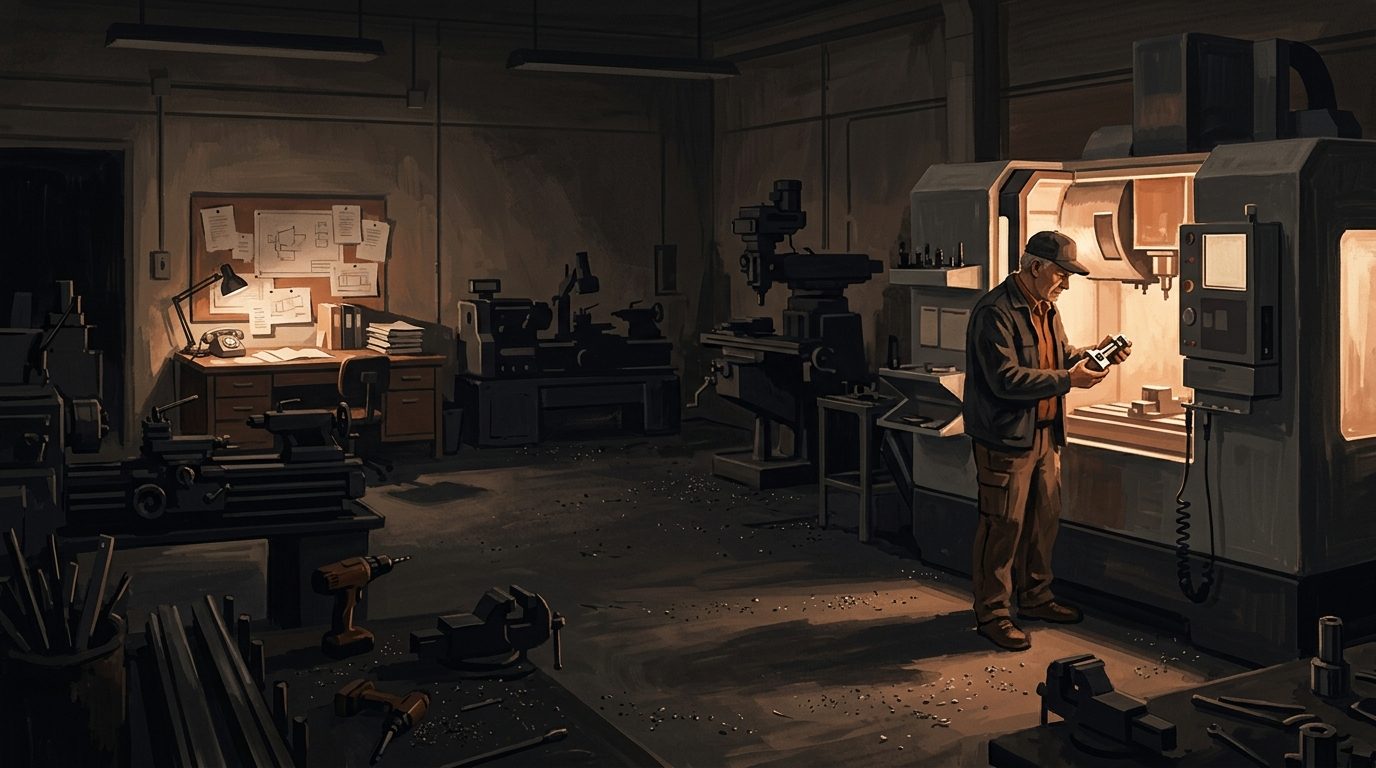
Picture it, because most owners do not need to. The scene is imagined; the numbers are not. The day shift left at four. The mill in the corner has forty parts in the queue, each one forty minutes a side, and a customer who was promised Friday. The owner loads a part, closes the door, presses cycle start, and has thirty-nine minutes to do the quoting, the invoicing and the phone call home. Then the door opens again. This is not a story about a lazy owner. It is a story about a machine that only runs when a human is standing there, in a building full of humans who are not.
What the shops did
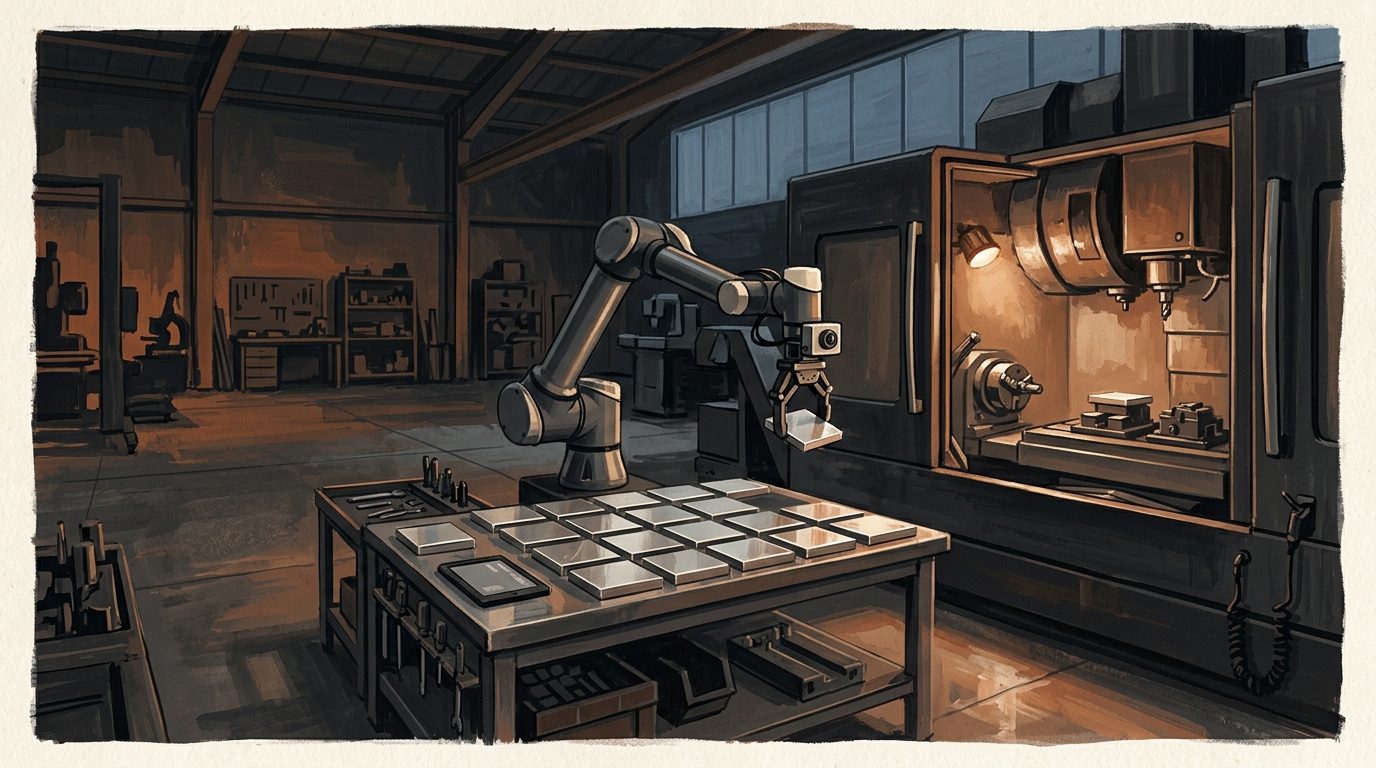
The casebook on this site carries two accounts. A 25 person optics shop in Mississippi that runs one order of about 6,000 camera housings each spring on a single Haas, 30 to 45 minutes a side, put a UR10 with a wrist camera in front of it. The shop sets 15 to 20 blanks on a table at the end of the day and the robot loads them through the night, four to six unattended hours, and daily output doubled, as the vendor published it. The account says plainly that the cycle time did not improve at all. The job finished sooner because the machine stopped waiting.
A 25 to 50 person shop in Washington won a medical device order that needed round the clock production and could not hire a third shift. A UR5e now tends the machining center through a three operation cycle. Weekly output rose from 255 to 370 parts and production cost fell 23 percent, as trade press and the vendor reported it, with a payback of about 12 months claimed by the vendor. The cycle runs 56 minutes and the robot works six of them.
What it felt like, inferred honestly
The accounts do not describe the owner's evening, so this piece will not pretend to quote one. But the arithmetic of a 56 minute cycle with six minutes of robot work is also the arithmetic of a person's time. Before, someone's fifty minutes were spent waiting. After, nobody's were. The optics shop's blanks go on the table at the end of the day and the owner goes home, which is a sentence that costs nothing to write and took that shop a robot, a camera and a table to earn.
The number
Spindle hours you can sell, at your rate, at your margin, in the hours the building used to be dark. The worked example on this site puts a cell adding 20 unattended hours a week on a machine with real backlog at about two and a half years to pay back at the midpoint of the planning range, and a year and a half at 30 hours. The same cell on a machine with no backlog pays back never, and the concierge says so, because an owner's evening is only worth buying back if the hours it frees can be sold.
What it takes
An automatic door, or a way to add one. Workholding that locates every part the same way, which is a discipline more than a purchase. Parts that can sit on a table or in a drawer in a known orientation. Chips, coolant and alarms planned for a night nobody is there. A card on the controller that says who to call, and a recovery plan so that the answer at 2 AM is usually nobody. The piece on this site about what happens at 2 AM is the unglamorous twin of this one, and the two should be read together.
The freedom, named precisely

Not freedom from work. Owners of small shops do not want that and would not know what to do with it. Freedom from the particular trap where the most skilled person in the building spends the most hours doing the least skilled job in it, because a machine cannot open its own door. The robot opens the door. The owner quotes the next job at a desk, or at a dinner table, and the machine in the corner, for the first time since it was bought, earns its keep all night.
If there is a machine in your shop with a queue behind it and nobody to stand there, describe it to Joe, the concierge on this site. He will ask about the door, the workholding and the backlog before he says a word about robots, and he will tell you how many evenings the arithmetic actually buys.
Related on this site
- CNC machine tending
- What changed when a Washington machine shop filled its night shift with a cobot
- What changed when a 25 person optics shop ran its Haas overnight
- Lights-out manufacturing: what actually happens at 2 AM
- I never thought we could afford a tending robot. The spindle hours said otherwise
A tending robot buys machine hours while the building is empty, and the first thing those hours purchase is the owner's evening. The arithmetic is spindle time sold. The reward is a dinner you were present for.
Put it to the test on your own job
Tell Joe what you are running and he will apply this to your numbers, including telling you when a robot is the wrong answer.
More notes