The back that stops hurting
Forty tons of wine in cartons, lifted by hand in a single eight hour shift. That is a published number from a German bottler, and it is also a description of a person's lower back at six in the evening. Here is what palletizing automation actually buys, told from the end of the line, with the arithmetic still attached.
The short answer
The end of a packaging line is the most honest place in a plant. Nothing is abstract there. A case arrives, weighs what it weighs, and has to go on the pallet now, because another one is right behind it. A person who does that for a shift has lifted a weight no gym would allow, in a rhythm no trainer would prescribe, and does it again tomorrow. A collaborative palletizer takes that rhythm away from the body and gives it to a machine that was built for exactly that and nothing else. The payback is usually measured in months. The thing you actually bought is harder to put in a spreadsheet, and this piece tries anyway.
Six in the evening
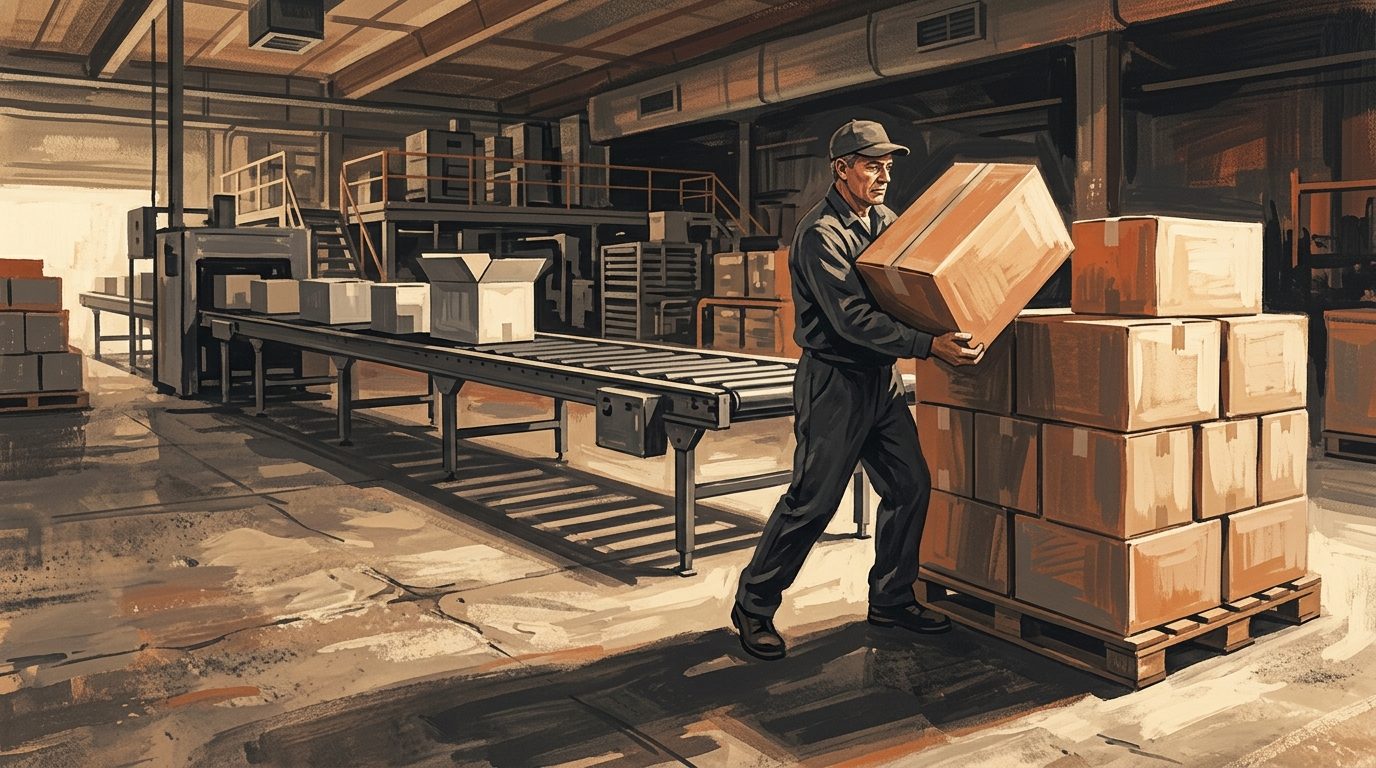
Picture the station at the end of a two shift day. The scene is imagined; the numbers in this piece are not. The line has run clean since two, which is good news for production and bad news for the person at the end of it, because a clean run means a case every forty seconds without the small mercies of a jam. By six the stack is shoulder high. The last layer is the heavy one, lifted up and away from the body, the lift every safety poster warns about and every stacker does three hundred times a week because there is no other way to finish a pallet by hand.
The casebook on this site carries a German contract bottler whose workers moved up to 40 tons of package weight in a single 8 hour shift before it automated, as the vendor published it. Forty tons. Read that as a fact about logistics and it is impressive. Read it as a fact about a spine and it is the whole argument.
What the robot does at six
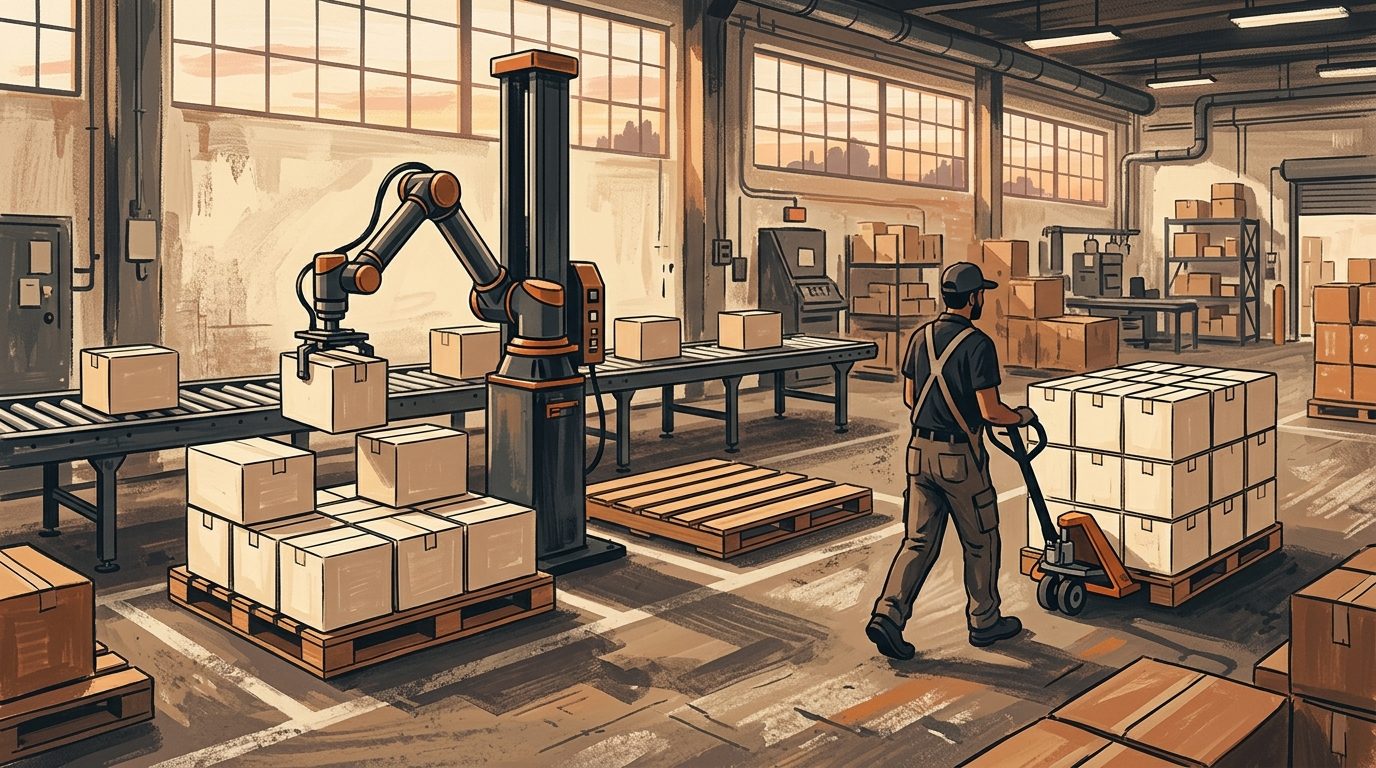
The same thing it did at two. That is its entire genius. The arm does not get tired, does not start lifting with its back, does not drop the corner of a case because the tape gave way and a hand slipped. In the California winery account in the casebook, cases of about 15 kilograms are picked at 6 to 10 a minute, as the vendor published it, hour after hour, and the person who used to stack them now swaps full pallets, loads stretch wrap and watches. The job did not disappear. The part of it that hurt did.
The number, because it matters too
The winery's maker publishes a prior manual palletizing labor cost of about 100,000 dollars a year and claims an 18 month payback. The worked example on this site, with made-up but realistic inputs, puts a two shift line at 13 to 22 months and a one shift line past three years, and says plainly which inputs move it. Those are the numbers that get the purchase order signed, and they deserve the honest treatment this site gives them. But sit with the stacker at six and you understand they are the smaller half.
The other half
Here is what a plant gets back that no quote line names. The person who stacked cases is still employed, in every published account in the casebook, and is now the one who knows how the cell works, which is a different kind of job and often a better paid one. The injury that was going to happen in year three does not happen. The turnover at the one station nobody wanted drops to the plant average. The line can run its peak without a second person pulled from somewhere else to catch the overflow. And the owner stops lying awake about the one job in the building that was, in plain language, hurting people slowly.
There is a kind of freedom in that which is easy to sentimentalize and should not be. It is not a robot setting anyone free. It is a plant deciding that a particular motion, repeated forty tons at a time, is a job for a machine, and then buying the right machine for it, with the risk assessment signed and the floor space measured and the peak rate counted on a Thursday.
What has to be true
The honest version keeps the disqualifiers in. Cases too flimsy for vacuum, a peak rate above what one arm holds with margin, no room for a second pallet position, an upstream bottleneck that leaves the robot waiting. The application guide on this site lists them before the pitch, because a palletizer that falls behind at peak gives the lifting straight back to a person, and that is the one outcome worse than never buying it.
The joy, specifically
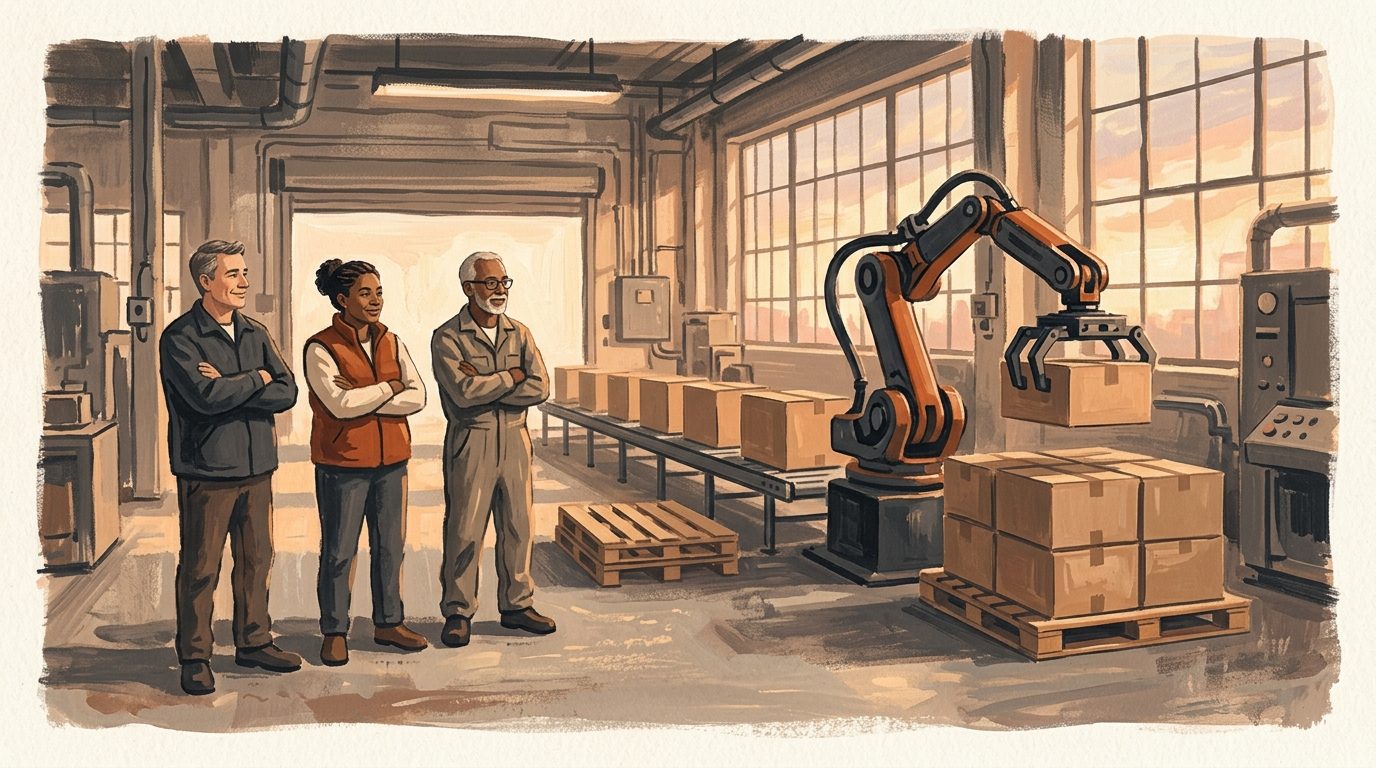
It is a small thing to watch. A case comes down the conveyor, the arm meets it without hurry, sets it exactly where the pattern says, and goes back for the next one, forever. People stand and watch this for longer than they expect to, and it is not the technology they are watching. It is the absence of a strain they had stopped noticing. Six o'clock arrives and nobody's back is involved.
If there is a station like that at the end of your line, describe it to Joe, the concierge on this site: cases an hour at peak, the heaviest case, how many shifts. The math takes ten minutes. The rest you will recognize when you see it.
Related on this site
- Palletizing
- What changed when a California winery stopped hand stacking wine cases
- I never thought we could afford a palletizer. Here is how the analysis plays out
- Size for peak, not average
- Robots for food and beverage plants
A palletizer returns the last hour of a stacker's day, which is the hour the mistakes and the injuries happen. The payback math is real, and it is the smaller half of what you bought.
Put it to the test on your own job
Tell Joe what you are running and he will apply this to your numbers, including telling you when a robot is the wrong answer.
More notes