The estimator's ladder
A roofing estimator climbs a ladder several times a week, carrying a camera and a moisture meter, to look at a roof that would rather not be walked on. A drone with a thermal camera changes the ladder into an option. Here is what aerial roof survey gives back to the people who do that work, with a federal program's published scale and the honest line about who may fly.
The short answer
Roofing is one of the most dangerous trades in the country, and the dangerous part is not the roofing. It is the getting up and the being up: the ladder, the edge, the membrane that is slicker than it looks, the deck that is softer than it should be. A survey aircraft with a good visual camera and a radiometric thermal one lets an estimator see the whole roof, and see under it, from the ground. The ladder becomes a tool for the day the work actually starts, and the estimator's knees, back and nerves get the rest of the week off.
Tuesday, on a flat roof
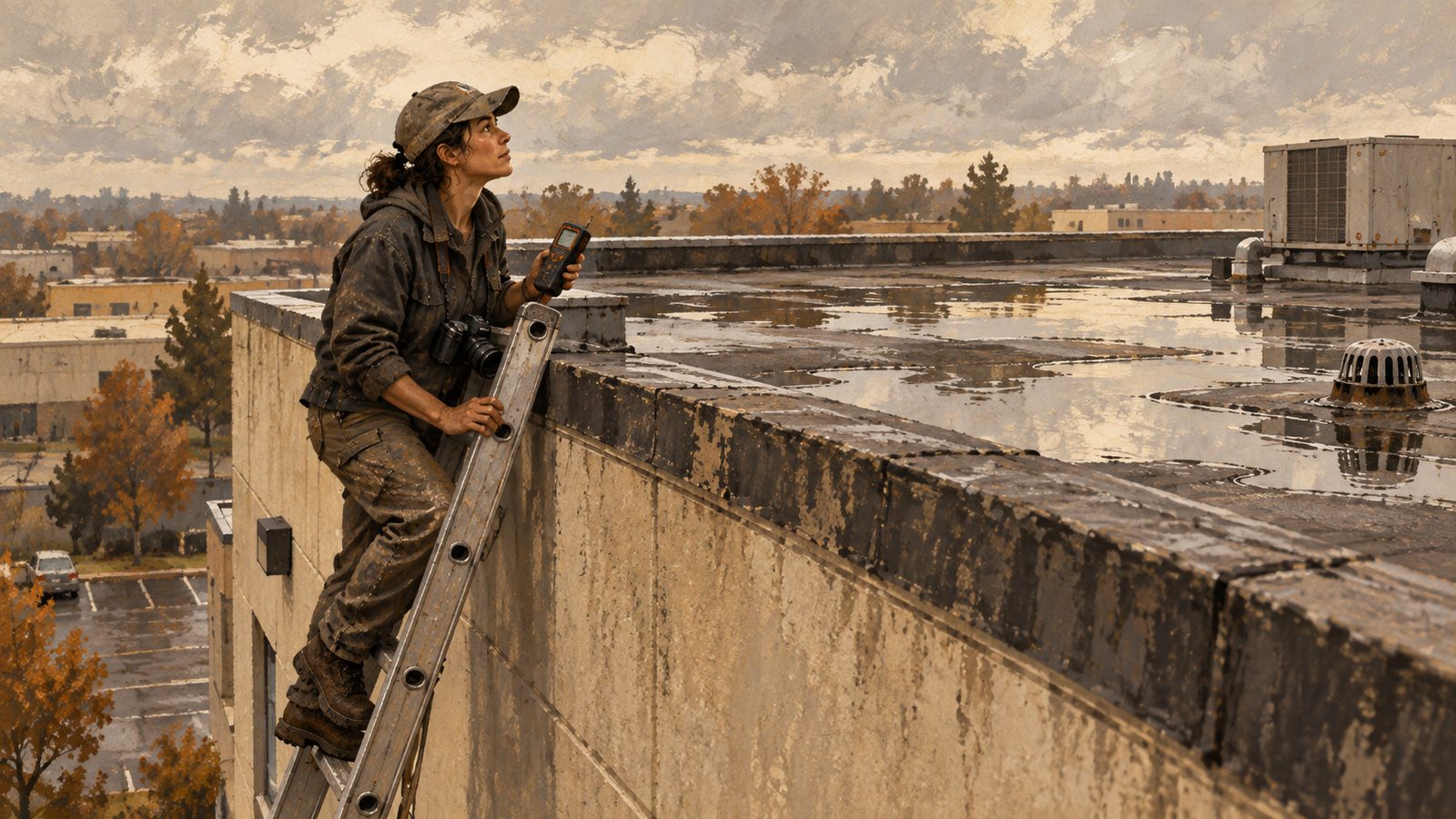
Picture a commercial roofing estimator at a property manager's building. The scene is imagined; the numbers below are not. A forty foot extension ladder, a camera, a moisture meter, and a roof of about 40,000 square feet of aging membrane with ponding in two places. Two to three hours of walking a grid, kneeling to probe, photographing seams, and writing it all up that night, with the report arriving a day later and the property manager asking what the roof under the gravel actually looks like. Multiply by four roofs a week.
What a federal program published
The casebook on this site carries the engineering firm Parsons, which supports the US Department of Labor's Job Corps program and uses drones to inspect campus roofs nationwide: high resolution, GPS tagged imagery of sloped roofs that cannot be safely accessed in person, and infrared data on flat roofs to locate potential leaks, warmer areas flagged as possible moisture under the membrane, as the firm published it. The published scale is 121 Job Corps Centers in all 50 states and Puerto Rico, inside a contract the firm lists at more than 100 million dollars for architecture, engineering and construction management as a whole, not for the drone work alone. Roof counts, hours saved and program cost were not published, and this site says so. The useful fact is structural: a national owner of hundreds of roofs decided that walking them was the wrong default.
What the aircraft actually sees
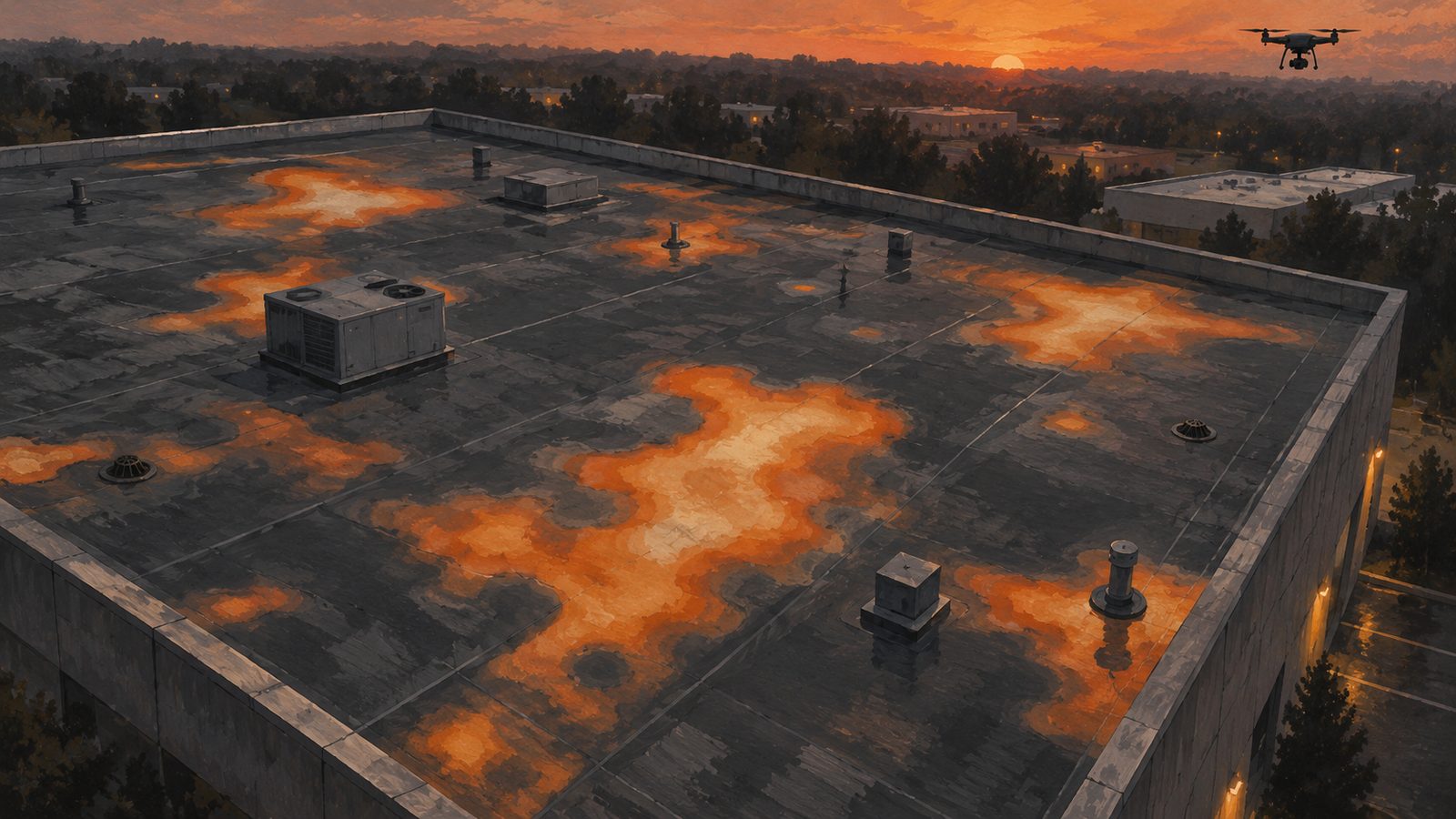
Two things the ladder never did. The whole roof at once, in a stitched image with every seam and drain, so that the condition report is a map rather than a memory. And heat: at dusk, wet insulation gives up the day's warmth differently from dry, and a thermal camera shows the moisture under the membrane as a shape on a screen. That shape is where the leak will be in two years, and finding it from the air at dusk is a different trade from finding it by probing a grid on your knees at noon.
The honest lines
Steel Collar sells and sources aircraft; it is never the operator of record and never pilot in command. Flying for a business in the United States typically involves a certificated remote pilot and rules about where and how you may fly, and the specifics belong with a qualified specialist, not a web page. For a contractor doing a few surveys a month, hiring a professional operator through the aerial services page may beat buying, training and insuring an aircraft, and the concierge says so without being asked. For the single small roof, the ladder still wins, and that is in the walkthrough on this site too.
The number
Hours per survey, roofs per week, and the day the report arrives. An aircraft turns a three hour walk into a flight and a stitched map, and turns the report into something a property manager can see for themselves. The camera and the software are often a larger share of the budget than the airframe, which surprises people, and the honest shortlist on this site says so. For a contractor with a portfolio of large roofs the arithmetic is quick. For a contractor with ladders and small roofs it is not, and the honest answer is to hire the flight.
The freedom, from the estimator's side
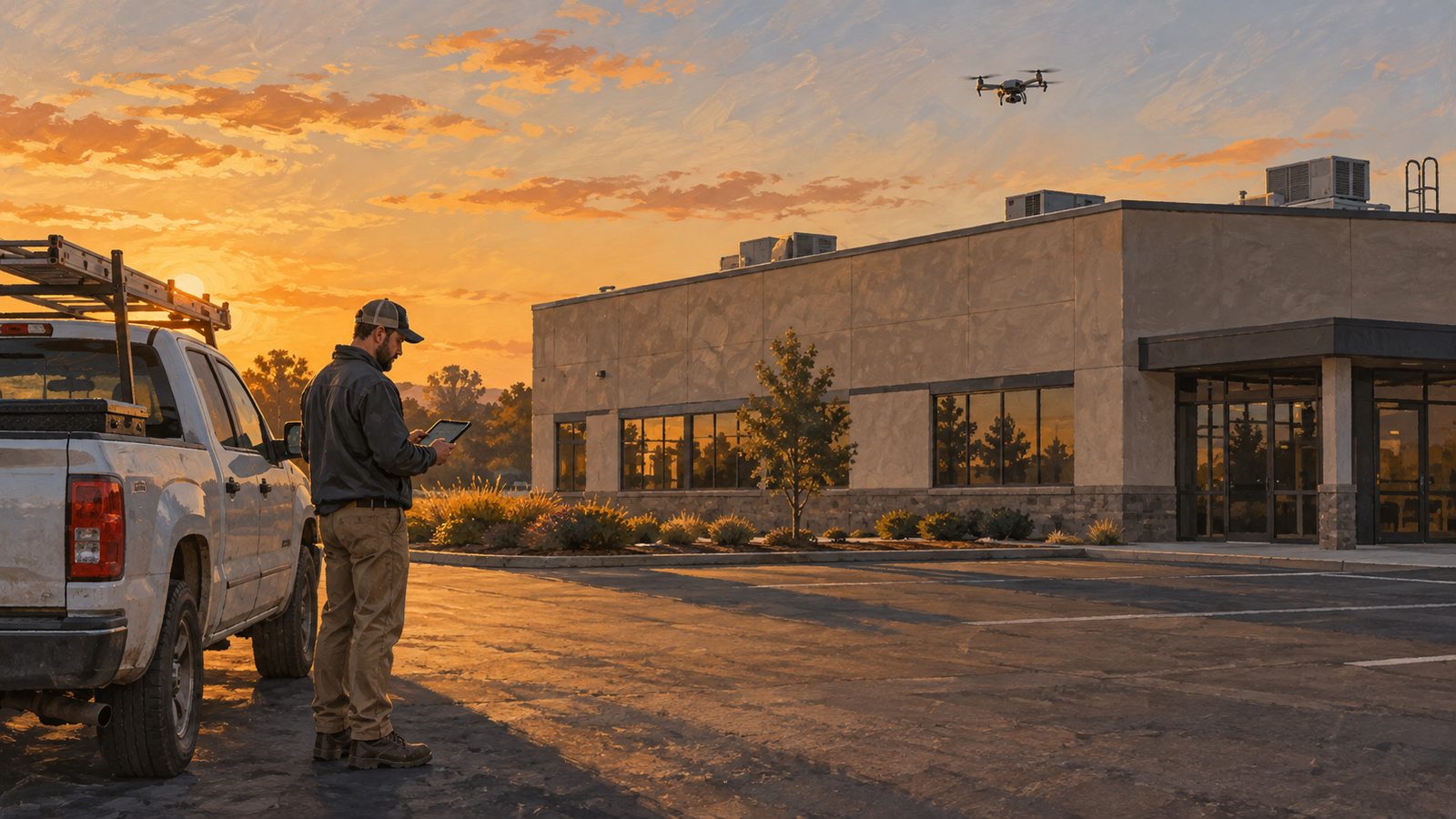
Not having to decide, four times a week, whether a particular roof is safe enough to walk. Seeing the whole roof instead of the part of it that was reachable. Telling the client what is under the membrane rather than guessing. And the smaller thing nobody writes down: an estimator who gets to the end of a career with the same knees they started it with.
Describe the roofs you inspect, how you do it today and who would fly to Amelia, the aerial concierge on this site. She will sort seeing from measuring, speak the compliance line aloud, and tell you whether to buy the aircraft or hire the flight.
Related on this site
- Roof and building envelope surveys
- Roof thermal survey
- What a walkthrough with Amelia looks like: a roofing contractor who thought drones were for surveyors
- The ladder before the drone
- Drones for roofing and building owners
Roof survey from the air pays back on ladders not climbed, roofs not walked and moisture found before it is a leak. Buy versus hire is the first decision, and the concierge will tell you which fits.
Put it to the test on your own job
Tell Joe what you are running and he will apply this to your numbers, including telling you when a robot is the wrong answer.
More notes