The steadiest hand in the building
A narrow bead of glue in a channel an eighth of an inch wide is a job that punishes the human hand: tremor, fatigue, and a scrap rate that climbs through the shift. One aerospace shop in Tacoma gave the bead to a cobot. The maker publishes output doubled, scrap from 15 percent to 3, and four operators' work done by one. This is about the hand.
The short answer
Some manufacturing jobs are hard because they are heavy. Some are hard because they are fast. A few are hard because they ask a human hand to be something it is not: perfectly steady, for eight hours, on a line the width of a pencil lead. Dispensing adhesive into a narrow channel is one of those, and the published account from Tool Gauge in Tacoma shows what happens when the steadiest hand in the building turns out to be a robot's. Output doubled and scrap fell from 15 percent to 3 percent, as the maker published it, and the people who used to shake their hands out at the end of the shift now do other work.
The channel
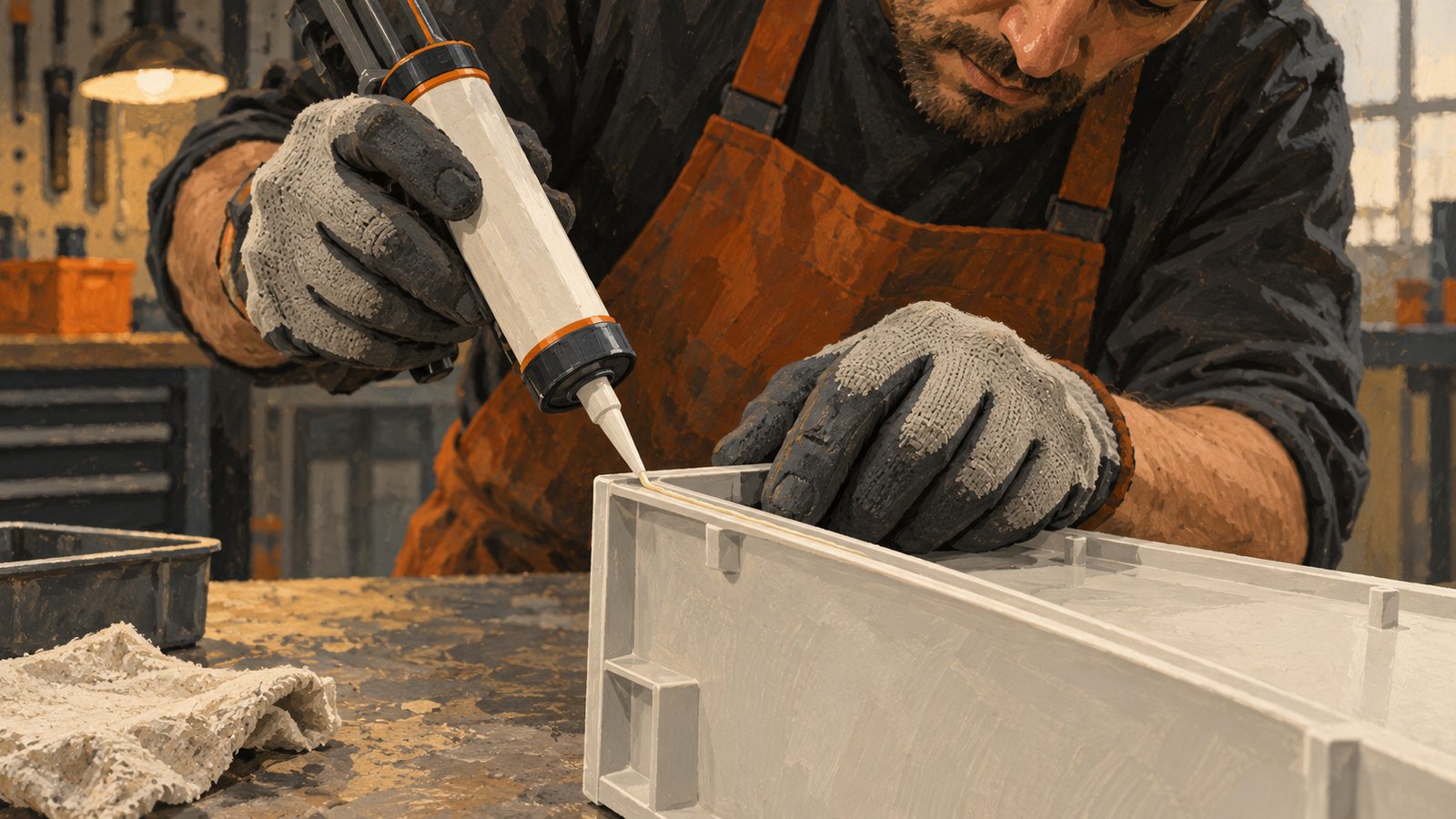
Picture the station. The scene is imagined; the numbers are the maker's. A plastic extruded panel with a channel along its edge, an end cap that has to be glued in, and a bead of adhesive that has to land in the channel and nowhere else. Four operators, about 200 units a day between them, hand fatigue by mid morning, and a scrap rate that said one unit in seven was not good enough. The shop was looking to hire as many as 100 people who did not exist in the local labor market, and this was one of the stations it could not staff.
What they put in

A UR5 that picks each end cap, carries it through a glue dispenser and places it into a clamping actuator on a table, where one operator inspects the bead and removes the part. No vision system. Separately, a UR3 that picks easily damaged copper machined parts off a CNC chute on a proximity sensor's signal, dips them in a rinse bath, holds them to a dryer and boxes them into a grid, freeing a journeyman machinist who had been doing nothing else.
What changed, in the maker's numbers
The glue cell went from about 200 units a day with four operators to 400 a day with one operator plus the robot. Scrap on the glue application fell from 15 percent to 3 percent. Labor cost savings of up to 75 percent. The UR3 cell saved 9,000 dollars on its very first order. Payback was expected under one year for both robots, explicitly worded as an expectation, against the shop's own initial assumption of three to four years. A reduction in injury claims is asserted without a figure. Cell cost and cycle times were not published, and this site says so.
Why the scrap number is the one to chase
On a narrow bead in a tight channel, most scrap is tremor and fatigue. Those are human variables, and a robot does not have them. It places the same bead at the same speed at the same depth on part four hundred as on part one. That is why a shop with a 15 percent scrap rate on a job like this has an enormous amount to recover, and a shop already at 4 percent has almost nothing. Measure the baseline before anyone quotes. The published gain is real; whether it is yours depends on a number only you have.
The honest reading
An operator still inspects and unloads every glued part, so this cell reduced a four person station to a one person station rather than removing the station, and a similar quote should be priced that way. The payback is an expectation, not a measurement, and the cost was not published, so the arithmetic cannot be rebuilt from the account. The UR3 job is the more copyable one for a typical shop, and it needed no vision at all, only a proximity sensor and a repeatable chute.
The hand, specifically

What the four operators got back was the use of their hands for something other than a tremor test. The shop's labor problem, 100 people it could not hire, was described as cut in half. The machinist who had been boxing copper parts went back to being a machinist. There is a particular kind of relief in handing the impossible version of a task to something that finds it trivial, and the people on that line would recognize it without needing the word.
If you have a station where the hand is the problem, a bead, a fastener, a placement, describe it to Joe, the concierge on this site. He will ask for your scrap rate before anything else, because that is where the money in this story lives.
Related on this site
- Adhesive and sealant dispensing
- What changed when an aerospace shop doubled a glue cell and cut scrap from 15 percent to 3 percent
- Assembly and screwdriving
- Pick and place
- The gripper is the project
When a job fails because of tremor and fatigue, a robot removes the variable outright. Measure your scrap baseline first; the published gain exists only if yours is high.
Put it to the test on your own job
Tell Joe what you are running and he will apply this to your numbers, including telling you when a robot is the wrong answer.
More notes