The nurse who stays with the patient
Hospitals move linen, meals, medications, specimens and surgical case carts all day, mostly by people who were hired to do something else. A mobile robot that can navigate a crowded corridor changes who pushes the cart. Here is what clinical hours returned look like, in a hospital's terms, with the honest list of what a building has to allow.
The short answer
The most expensive cart in a hospital is the one a nurse is pushing. Not because of the cart, but because of the nurse, who is a scarce, trained, exhausted person walking a case cart or a medication tote across a building while a patient waits. A mobile robot built for hospital corridors takes the scheduled, repetitive routes: sterile carts to the operating rooms, pharmacy totes to the wards, meals, linen, specimens to the lab. The honest frame this site uses is clinical hours returned, and it is a frame hospitals recognize the moment they hear it.
Two in the afternoon on the surgical floor

Picture it. The scene is imagined; the facts about the machines are not. A sterile processing technician has a case cart ready for a four o'clock procedure three floors up and across the building. The elevator is slow. The corridor is full of beds, visitors and a food cart. Twelve minutes each way, twice an afternoon, for a person whose actual job is making sure the instruments are sterile and complete. Meanwhile a nurse on a medical floor walks to pharmacy because the tote did not come, and a patient's call light stays on for the length of that walk.
What the machines are
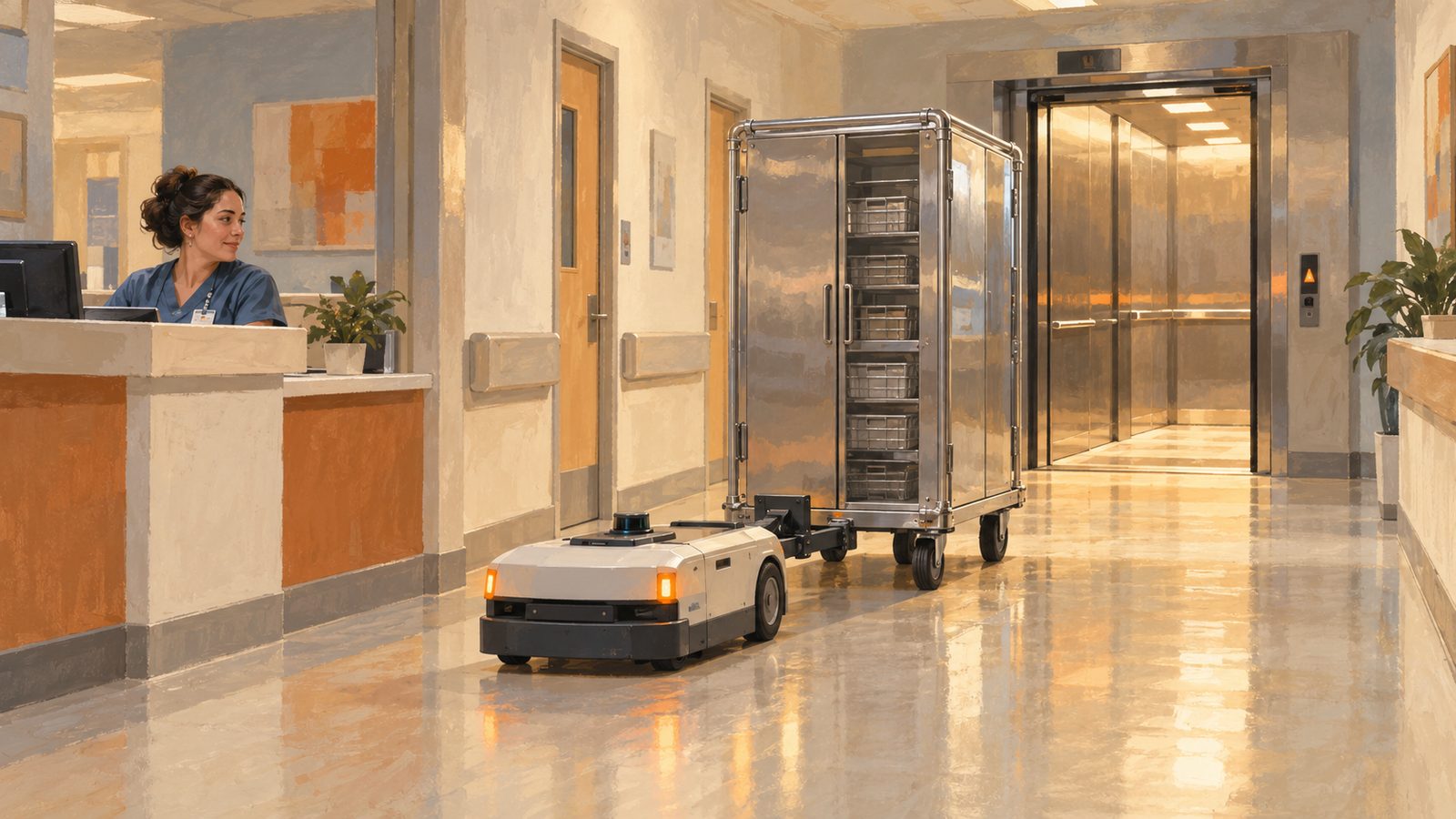
The matrix on this site lists purpose built hospital tuggers alongside general mobile robots. The Aethon TUG T3, verified against the maker's material in September 2026, is a hospital cart tugger rated for about 340 kilograms, carts to 44 inches, 12 hours of runtime and automatic charging, built for pharmacy, laboratory, linen, nutrition and surgical carts, and sold and supported directly by its maker, as the matrix records it. What changed to make these possible is natural navigation: a robot that reads the building once and finds its own way through people, with safety rated sensing, elevator and door integration, and a tablet to summon it.
Why hospitals waited
Corridors are the worst case for a vehicle: narrow, crowded, shared with beds, broken by fire doors and elevators, changing hour to hour. The first generation of automated vehicles followed tape and stopped for a wheelchair. And nobody owned the hours, because pushing a cart was a few minutes here and there spread across nurses, technicians and aides. Hospitals are good at counting what they bill and bad at counting what they walk. The business case was invisible until somebody put a stopwatch on it.
The arithmetic, done the hospital's way
Pick one scheduled route. Count the trips a day, the minutes each takes, and who makes them. Multiply by the loaded cost of that person's hour, which for a nurse or a sterile processing technician is a number the finance office knows exactly. The worked example this site uses for mobile robots applies here with one difference: in a hospital, the hours almost always convert, because the people who stop pushing carts have patients waiting. Then add the deployment honestly. Elevators, doors and infection control each need engineering, so a hospital deployment takes longer than a warehouse one and the integration line is larger.
What has to be true
Corridors wide enough for a cart and a bed to pass. Elevators that can be integrated. Routes that do not need a person at both ends for custody, counting or patient contact. Floors and thresholds the robot can cross. And a department willing to own the hours, the routes and the charging station, which is the organizational version of all of the above and the one that most often decides it.
The freedom, specifically

It belongs to the nurse who stays with the patient, the technician who stays with the instruments, and the aide who stops being the building's circulatory system. Nobody is replaced. The published accounts of hospital robots describe people reassigned to the work they trained for, and the people themselves describe it as getting their job back. There is a dignity in that which hospitals understand better than most workplaces, because they know exactly what a nurse's hour is for.
Pick one route, walk it, note every door and elevator, and count the trips. Then describe it to Joe, the concierge on this site. He will size the robot against your cart weight, name candidates from the matrix including the hospital tuggers, and tell you which parts of the building the integrator will need to engineer around.
Related on this site
- Case cart and sterile tray transport
- Moving carts through a hospital wasn't automatable until a robot could navigate without tape on the floor
- Material movement
- Robots for hospitals and healthcare
- Aethon TUG T3
Hospital transport robots return clinical hours to clinical people. The arithmetic is trips a day times minutes times who makes them. The reward is a nurse who did not leave the floor.
Put it to the test on your own job
Tell Joe what you are running and he will apply this to your numbers, including telling you when a robot is the wrong answer.
More notes