The dust that goes away
Sanding and grinding are the jobs a plant hides at the back, behind a curtain, under a dust collector older than the people using it. A force controlled robot does the sanding. The dust is still there, but the person breathing it is not. Here is what finishing automation returns, with a Virginia fabricator's published numbers and the consumable the robot will burn faster.
The short answer
Walk to the back of almost any fabrication shop and you will find the finishing room, and in it the job that turns over fastest, pays least, and sends the most people to the doctor. Sanding, grinding and deburring are repetitive, loud, dusty and physically hard, and the quality drifts late in the shift because a tired arm eases off. A robot with force control does the same pass at the same pressure on the last part as the first. The published numbers describe rework and output. The quieter number is the one about lungs.
Behind the curtain
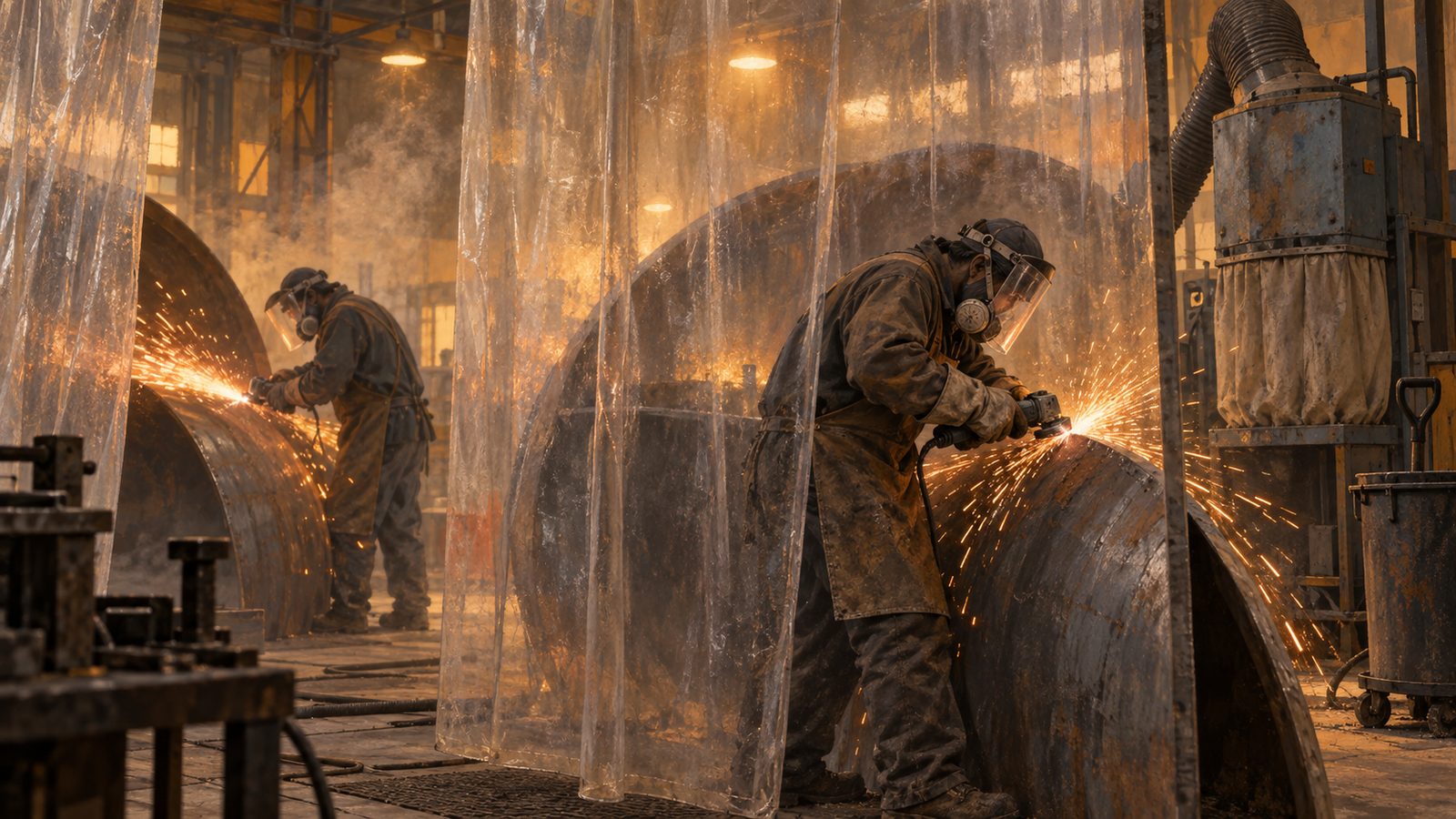
Picture a finishing room at two in the afternoon. The scene is imagined; the figures below are published. Two people in respirators working weld seams on steel shells with angle grinders, sparks into a collector that was adequate in 2009, a radio nobody can hear. The first shell of the morning was finished to a standard. The twentieth is finished to a slightly different one, because that is what arms do after five hours of vibration. A third person is doing rework on yesterday's twentieth shell.
What the Virginia fabricator published
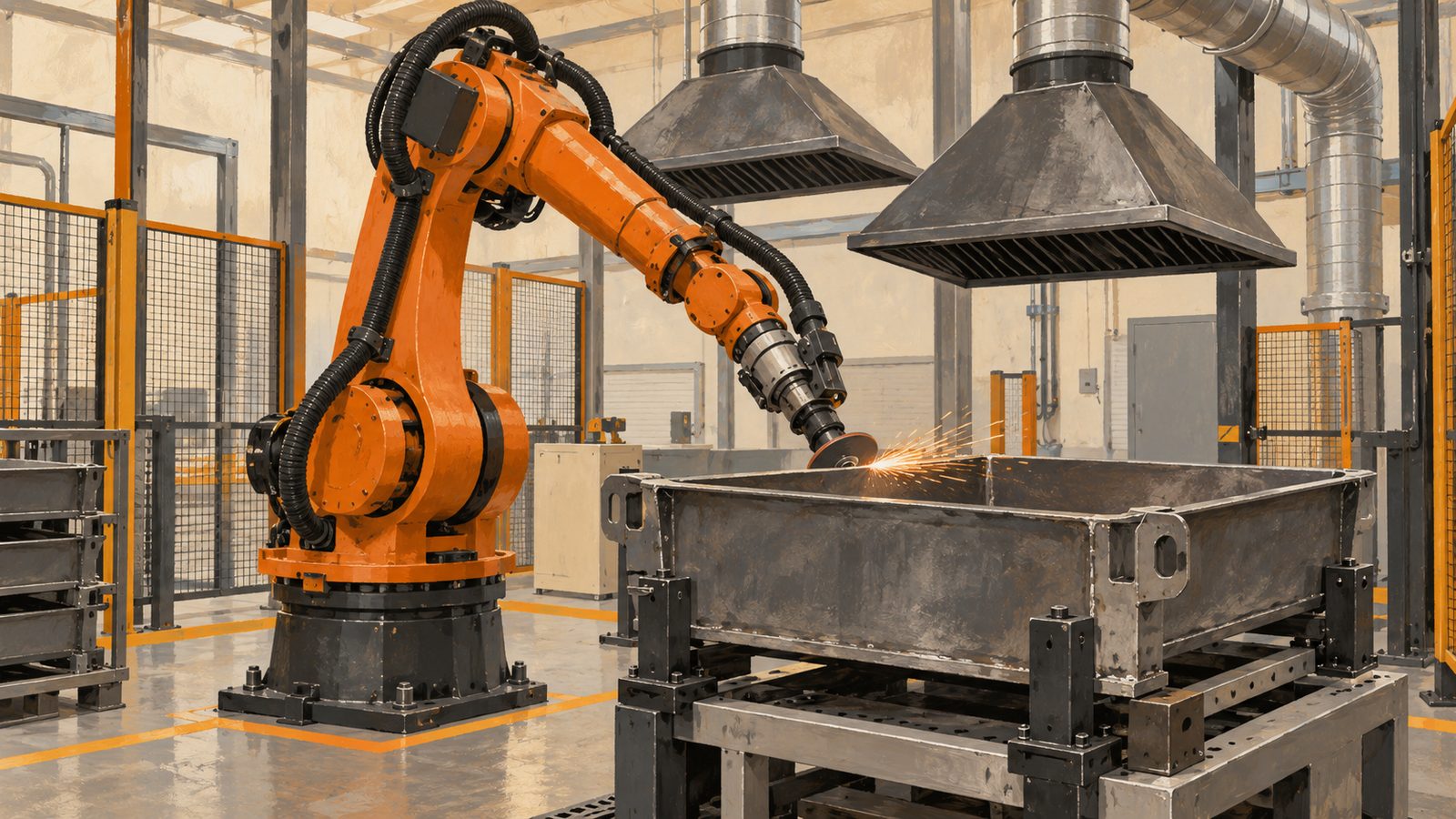
The casebook on this site carries Lawrence Brothers of Bluefield, Virginia, which grinds 1,000 metal material handling trays a day. The maker describes the job as tiresome and injury prone; it drove high turnover in a region with a limited workforce and sent eight to ten trays a day back for rework. A FANUC arm running software that scans each incoming tray and generates its own grind path now does it, so the part type can change every cycle. The vendor publishes production up 38 percent, rework down 95 percent, from eight to ten trays a day to eight to ten a month, and 2,000 dollars a week saved on grinding discs. Displaced grinders moved into robot operating roles rather than being let go. Payback and cell cost were not published, and this site says so.
Two German accounts in the same casebook, both from a force control tooling maker, describe the other end of the scale: a thirteen person stove builder whose grinding staff were relieved of the weld seam task entirely, with the vendor claiming 75 percent time savings and 33 percent abrasive savings, and an exhaust maker taking a tailpipe seam from four to five minutes by hand to under one minute, claiming 70 percent abrasive savings. Read all of those as vendor claims. Notice that they point in both directions on abrasive, which is why this site's worked example adds 30 percent to the manual baseline and tells you to measure your own.
Consistency, which is a quality word and a safety word
A force controlled tool presses with the same force on every pass, which means the finish on part two hundred matches part one, which is a quality argument. It also means the robot does not ease off, which is why it can use more abrasive than a person, which is a cost argument that belongs in the math. And it means the person who used to hold the grinder for six hours now loads the part, checks the finish and changes the belt, which is an exposure argument that the published accounts make by implication every time they describe grinders becoming operators.
The dust
Here is the thing nobody puts in the quote. Dust collection is often the most expensive part of a finishing cell after the arm, and it is also the part that was inadequate before the robot and would have stayed inadequate forever, because the people breathing the dust were not the people approving capital. A robot cell forces the extraction question, because the integrator will not sign the cell without it. The lungs in the room get a budget line they never had.
The honest limits
Mostly curved or profiled parts the end effector cannot follow. Cosmetic standards on visible surfaces that still want a person's eye for the final pass. Random part presentation, which is a fixture problem to solve first. A shop where cutting or assembly is the real bottleneck, so the finishing cell would wait. And the operating math, which has to include the abrasive line or it will surprise you.
The freedom, in plain terms
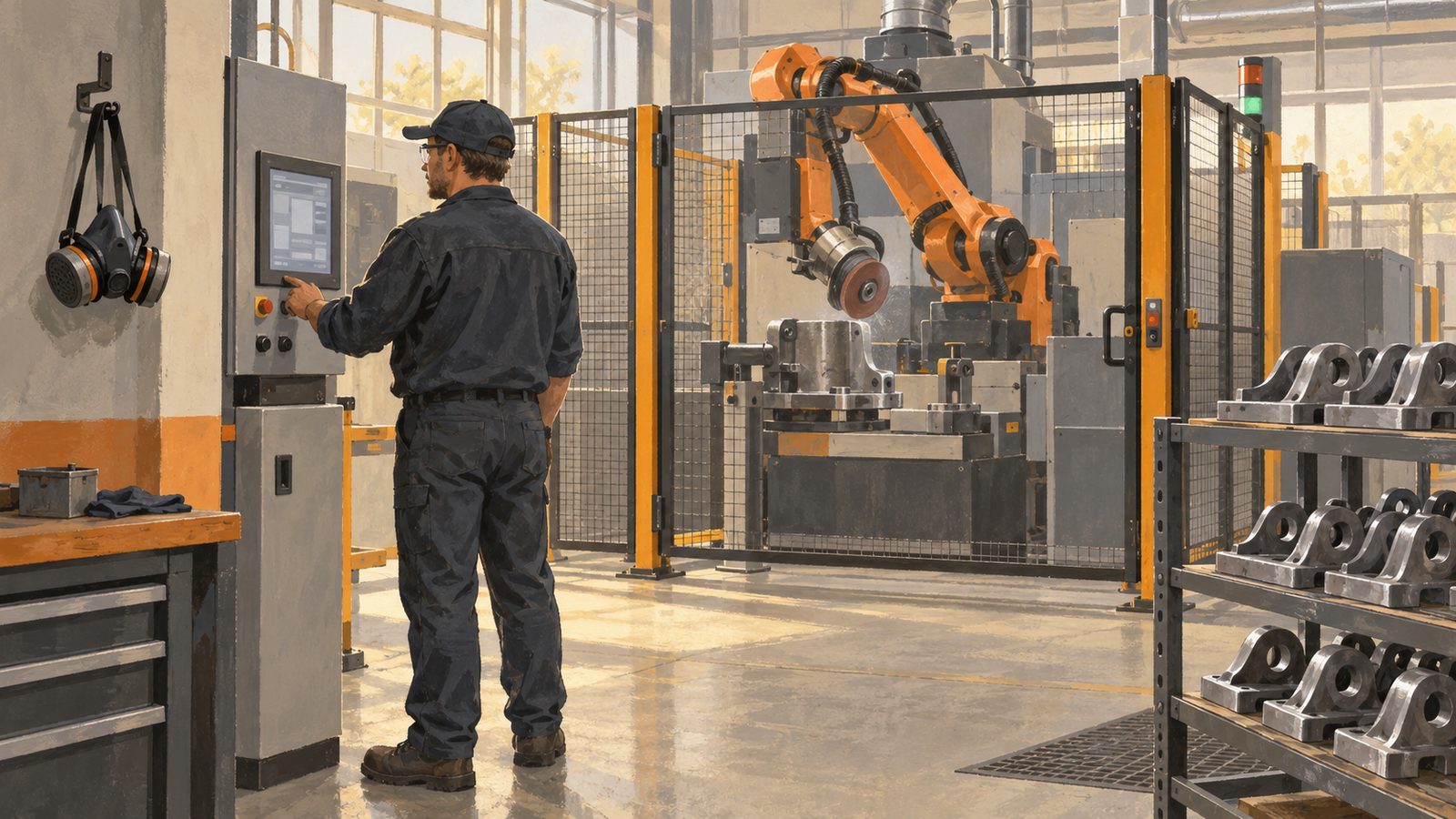
The job that nobody wanted becomes the job of running the machine that does it, which people do want. The rework bin empties, which the Virginia numbers show more vividly than any sentence can. The finish on the last part looks like the finish on the first. And a room that was behind a curtain for a reason gets a dust collector sized for the work, because a robot needed one.
Sort a month of parts into flat and profiled, count the sanding hours, and pull your abrasive spend. Then describe the finishing room to Joe, the concierge on this site. He will put the figures in the frame, name the class of cell and tooling that fits, and remind you to budget the extraction, which is usually the surprise line.
Related on this site
- Sanding and finishing
- What changed when a Virginia fabricator put a robot on grinding 1,000 trays a day
- Deburring wasn't automatable in a small shop until force control grew up
- I never thought we could afford a sanding robot. The dust and the overtime said otherwise
- Weld seam grinding
A finishing robot frees labor, holds consistency to the last part, and takes the human lungs out of the dust. It uses more abrasive, and the honest math includes it.
Put it to the test on your own job
Tell Joe what you are running and he will apply this to your numbers, including telling you when a robot is the wrong answer.
More notes